
Organic Soy Sauce Sourcing: 8 Questions Buyers Overlook
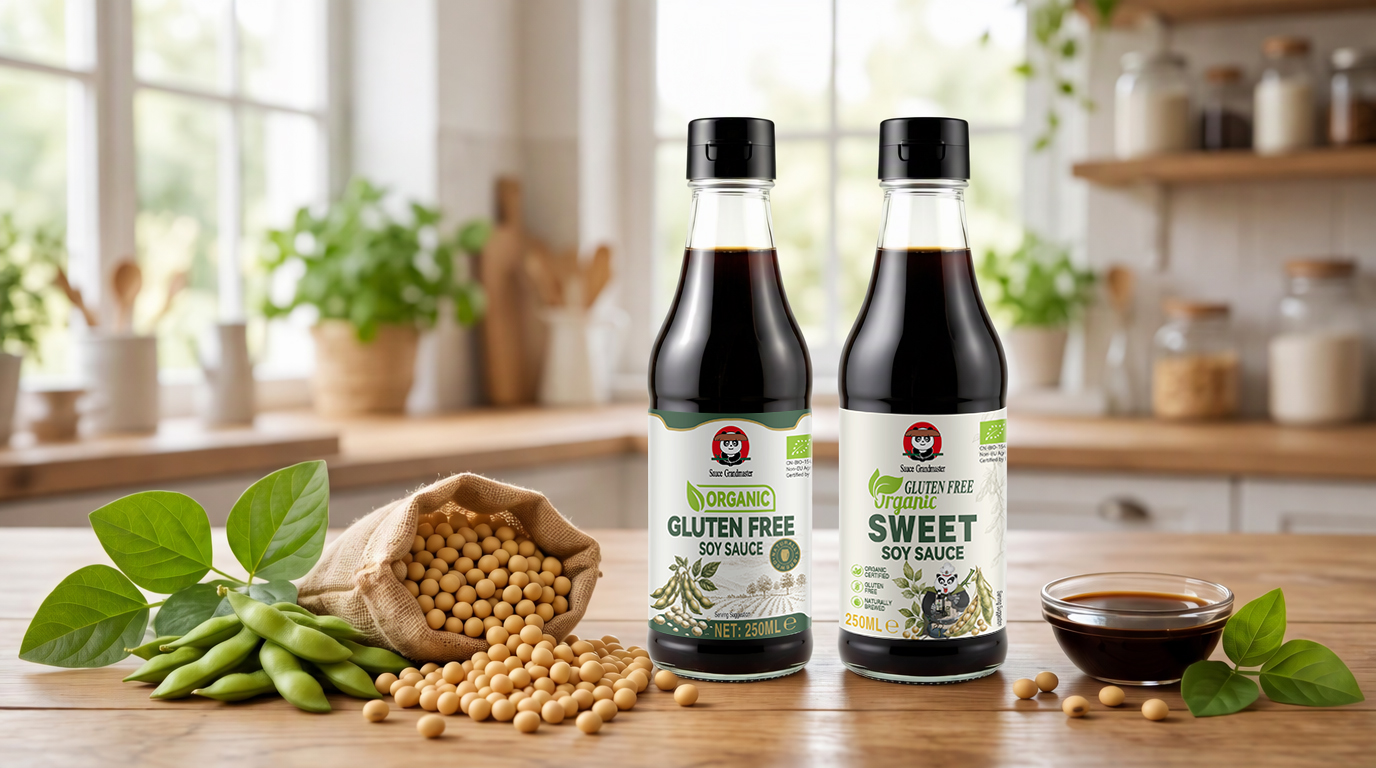
Sourcing organic soy sauce for retail distribution, supermarket chains or foodservice supply is not simply a matter of swapping conventional soybeans for certified organic ones on a specification sheet. A unit price per liter or a generic certificate PDF won’t tell you whether your shipment will clear destination customs or hit your retail shelf window.
Commercial organic soy sauce supply requires a fully integrated manufacturing system in which every stage—from certified agricultural raw materials and koji cultivation to moromi fermentation, pressing, pasteurization and bottling—operates under an audited organic chain of custody. Whether you are importing branded retail glass bottles, foodservice catering pails, or spray-dried organic soy sauce powder in bulk, operational reliability is governed by physical batch segregation and biological fermentation cycles.
Audit the chain of custody, the fermentation tank allocation and the transaction certificate timeline together. An organic farm certificate for soybeans does not authorize a bottling plant to label finished soy sauce as organic, nor does an organic brew bypass the 90-to-180-day biological fermentation clock.
What does “organic” actually require in commercial soy sauce supply?
In export condiment manufacturing, “organic” is a process-and-traceability system, not just an ingredient specification. For a finished bottle or bulk tote of soy sauce to carry a legal organic claim in the European Union, the United States or other regulated markets, three operational pillars must align:
1. Certified agricultural raw-material chain
Whole soybeans (or certified organic defatted soy meal where permitted without prohibited hexane extraction) and organic wheat—or organic rice/corn substrates for gluten-free Tamari-style lines—must originate from farms holding valid organic certification. Non-agricultural inputs, namely water and food-grade salt, are excluded from the organic percentage calculation but must meet purity and additive restrictions.
2. Accredited processor and handler scope
The manufacturing plant that steams the beans, inoculates the Aspergillus oryzae starter, manages the fermentation tanks, presses the mash and fills the final packaging must hold an active Organic Processor/Handler certificate issued by an accredited certifying body recognized in the destination market.
3. Physical batch segregation and sanitation
When a facility produces both conventional and organic condiments (split or parallel production), the manufacturer must enforce documented physical separation, dedicated fermentation tanks, validated clean-in-place (CIP) purge protocols and mass-balance accounting so zero commingling or prohibited chemical sanitizer carryover occurs.
If any link in this chain breaks—for example, if a supplier buys certified organic raw soy sauce in bulk IBC totes and rebottles it on an uncertified filling line—the finished product forfeits its organic status. For a foundational look at brewing mechanics, see our naturally brewed soy sauce guide.
What are the 8 questions B2B buyers forget to ask?
Most RFQs ask whether the factory “has organic certification” and what the price per carton is. Experienced category managers, regional distributors and importers dig into the operational friction points where delays and customs holds actually happen:
1. Does the processor certificate cover both brewing and final packaging at the exact manufacturing site? Some suppliers hold an organic certificate for a trading company or a bulk fermentation yard, while subcontracting retail bottling to a secondary facility that lacks organic handler scope.
2. Which target-market standard is the facility certified to—and is a bilateral equivalence arrangement required? EU Organic (Regulation (EU) 2018/848), USDA NOP, JAS (Japan) and China Organic have different rules. Depending on origin and destination, you may need direct certification to the destination standard rather than relying on expired equivalence assumptions.[1][2]
3. Are any agricultural raw materials sourced from farms in “in-conversion” (transition) status? Crops harvested during the transition period before full organic status cannot be labeled as full organic in finished multi-ingredient condiments in most export jurisdictions.
4. How are parallel conventional and organic lines segregated against cross-contamination and allergen carryover? If a plant brews standard wheat-containing soy sauce alongside organic or certified gluten-free Tamari-style soy sauce, ask whether fermentation tanks are strictly dedicated and how shared pasteurizers and filling lines are purged and swab-tested.
5. Which sanitizers, defoamers and filtration aids touch the organic batch? Peracetic acid, hydrogen peroxide or other substances used in CIP must comply with the permitted substances list of the target organic standard, or be followed by a verified potable-water rinse with zero residue.
6. Is the starter culture (Aspergillus oryzae) and any yeast strain compliant with non-GMO and organic rules? Certifying bodies require signed non-GMO and non-ionizing-radiation declarations for all microbial cultures and enzymes used in koji and moromi stages.
7. How long does the certifying body take to issue the Transaction Certificate (TC) or Certificate of Inspection (COI) per shipment? In the EU (via TRACES COI) and the US (via NOP Import Certificate), the certificate must be endorsed before or alongside export clearance. A slow document turnaround can leave containers incurring demurrage at the port.
8. Does the factory maintain aged organic mother sauce in reserve, or is every production lot brewed from scratch upon order? If no certified base mash is aging in tanks, your initial purchase order must absorb the full 3-to-6-month fermentation cycle before bottling can even begin.
Vetting check, operational risk and what to verify before contracting:
| Audit check | Why buyers get caught | Required verification evidence |
|---|---|---|
| 1. Facility vs. trading scope | A supplier shows a valid organic certificate that belongs to a raw-material vendor or an uninvolved sister plant. | Match the physical factory address on the organic certificate and FDA/customs registration to your supply contract. |
| 2. Destination-market standard | Assuming any “organic” certificate is globally interchangeable across EU, US, UK or Asian customs borders. | Confirm the exact regulation code on the certificate annex and verify current certifying-body accreditation. |
| 3. In-conversion raw materials | Lower-cost transitional soybeans are blended into the mash, disqualifying the finished label claim. | Review the raw-material supplier’s lot certificate and the plant’s incoming organic mass-balance log. |
| 4. Parallel production & gluten-free isolation | Shared pressing cloths, holding tanks or fillers introduce conventional residue or wheat gluten into organic/Tamari runs. | Require tank-dedication maps, CIP purge SOPs, first-run discard volumes and ELISA gluten test reports (<20 ppm). |
| 5. Processing aids & CIP sanitizers | Silicon defoamers, prohibited filter aids or quaternary ammonium sanitizers leave non-compliant residues. | Audit the master list of processing aids and sanitation chemicals approved by the facility’s organic certifier. |
| 6. Starter cultures & carrier starches | For organic soy sauce powder bulk orders, conventional maltodextrin is accidentally used as the spray-drying carrier. | Require non-GMO culture declarations for liquid sauce, and certified organic maltodextrin/starch specs for powders. |
| 7. TC / COI issuance timing | Container arrives at destination port before the EU TRACES COI or NOP Import Certificate is endorsed. | Build a mandatory 7-to-14-day pre-shipment document window into the letter of credit or purchase contract. |
| 8. Mother-sauce tank inventory | Buyer expects a 30-day delivery, unaware that organic mash must be fermented from raw beans upon order. | Confirm whether the quote draws from aged organic moromi stock or requires a newly brewed batch. |
Why are organic soy sauce wholesale MOQs higher—and how does line scheduling work?
In commercial organic soy sauce production, the Minimum Order Quantity (MOQ) is dictated by the volume of a dedicated fermentation tank or the minimum batch size that justifies a full organic line purge—not merely by the speed of the bottling machine.
When a manufacturer switches a bottling or spray-drying line from conventional soy sauce to an organic SKU, regulations require a complete teardown or validated CIP cycle, followed by a documented purge (often discarding the first liters of product) and ATP/allergen swabbing. Because this downtime and purge waste are fixed per run, small runs carry a steep unit-cost penalty.
How production stages shape realistic organic wholesale minimums
| Production stage | Operational constraint | Practical impact on buyer MOQ |
|---|---|---|
| Dedicated moromi fermentation | Soybean steaming, koji rooms and brine fermentation tanks operate in fixed metric-ton capacities (e.g., 10 MT to 50+ MT per tank). | Special-grade or market-specific organic formulas require committing to a full tank yield, either shipped in one lot or drawn down under a scheduled supply contract. |
| Pressing, pasteurization & filtration | Filter presses, diatomaceous earth beds and plate heat exchangers hold dead-volume liquid and require full sanitation between conventional and organic runs. | Small blending or pressing batches lose a higher percentage of yield to line holdup and mandatory purge flushes. |
| Retail bottling & market-version labeling | Filter presses, diatomaceous earth beds and plate heat exchangers hold dead-volume liquid and require full sanitation between conventional and organic runs. | Selecting established export, US or EU packaging versions in standard bottle formats (e.g., 150 mL, 252 mL or 500 mL glass, or 1000 mL cylindrical PET) keeps MOQs far more accessible. |
| Bulk foodservice & industrial formats | Pails (5-gallon / 20 L), 200 L drums, 1000 L IBC totes, or bulk bags of spray-dried soy sauce powder streamline retail packaging changeovers. | Ideal for food manufacturers or B2B foodservice distributors: MOQ is governed by liquid batch size or spray-dryer tower run rather than retail case components. |
Factory confirmation required. Specific MOQs, unit prices and tank allocations depend on whether you select an existing certified organic brand line in standard export/regional packaging or a dedicated bulk specification. Always confirm exact minimums in writing with the factory for your target SKU.
To optimize your initial inventory investment without violating organic batch economics, ask whether your order can be fulfilled from scheduled production runs of our core certified organic light or gluten-free Tamari-style lines, or structured across quarterly container call-offs.
How do GB/T 18186-2025 and export-market organic rules interact?
When sourcing from an export-oriented manufacturing plant in China, your product specification must satisfy both the manufacturing country’s national food standards and the destination market’s organic and food-labeling laws.
Brewing authenticity and GB/T 18186-2025
China’s updated national standard for brewed soy sauce, GB/T 18186-2025 (Quality General Rules for Soy Sauce), reinforces strict definitions for naturally fermented soy sauce, prohibiting the adulteration of brewed soy sauce with acid-hydrolyzed vegetable protein (HVP) liquid to falsify amino acid nitrogen grades.
Under both GB/T 18186-2025 and international organic standards, organic soy sauce must be 100% naturally brewed via microbial fermentation. Acid-hydrolyzed protein seasonings are chemically produced using hydrochloric acid and cannot be certified organic. Furthermore, key quality tiers (such as Special Grade / 特级, requiring amino acid nitrogen ≥ 0.80 g/100 mL in standard high-salt liquid-state brewing) must be achieved purely through raw-material protein ratios and fermentation management, because synthetic amino acids, MSG and artificial colorings are prohibited in organic formulations.
Ingredient thresholds and clean-label constraints
-
- Organic percentage tiers: Both EU Organic and USDA NOP require at least 95% of agricultural ingredients (by weight, excluding water and salt) to be certified organic to bear the primary “Organic” product name and seal. Any remaining 5% allowance is strictly limited to specific non-organic agricultural ingredients on the statutory positive list that are commercially unavailable in organic form.
- Zero synthetic preservatives or caramel color: Conventional economy soy sauces often rely on potassium sorbate, sodium benzoate or Class III/IV caramel color (E150c/E150d). None of these are permitted in organic soy sauce. Shelf stability in organic brewing relies on natural salt levels, controlled pH, pasteurization, hygienic hot/clean filling, or naturally fermented alcohol.
- Thickening and gluten-free substrates: If your product portfolio includes an organic sweet soy glaze, teriyaki sauce or gluten-free thick soy sauce, any starch thickener (such as corn starch used in gluten-free lines) or sweetener (organic cane sugar or rice syrup) must be certified organic and non-GMO. For gluten-free claims in the US and EU, the formula must replace wheat entirely (typically using organic soybeans, water, salt, and organic rice or corn starch where applicable) and validate finished batches below 20 ppm gluten.
Which documents must be in your organic import compliance pack?
Never release a balance payment or book a vessel without verifying that the manufacturer’s QA team can assemble the complete lot-specific dossier. A missing declaration will stall customs clearance or trigger a retail compliance hold.
Mandatory documents for B2B organic soy sauce imports
| Document | Issuing party | Critical buyer check |
|---|---|---|
| Master Organic Certificate & Product Annex | Accredited Certifying Body | Verify validity dates, certification standard (e.g., EU / NOP), and confirm that “soy sauce” (or soy sauce powder) is explicitly listed on the scope annex. |
| Transaction Certificate (TC) / COI / NOP Import Cert | Certifying Body (per shipment) | Matches the exact commercial invoice, bill of lading, net weight, lot numbers and consignee importer of record. |
| Batch Certificate of Analysis (COA) | Manufacturer QA / Third-Party Lab | Covers physico-chemical specs (amino acid nitrogen, total nitrogen, NaCl, pH, Brix), microbiological limits, heavy metals, and 3-MCPD compliance. |
| Pesticide Residue & Contaminant Screen | ISO 17025 Accredited Lab | Multi-residue screen confirming absence of prohibited agrochemicals, plus aflatoxin B1 / ochratoxin A checks on fermented soy/grain substrates. |
| Allergen & Gluten-Free Statement | Manufacturer QA (+ ELISA report) | Declares soy (and wheat, if standard koikuchi/light style). For gluten-free lines, attach batch ELISA test results (<20 ppm) and line-isolation SOPs. |
| Non-GMO & Culture Declaration | Manufacturer & Input Suppliers | Certifies that soybeans, grains, any starch carriers and Aspergillus fermentation cultures are non-GMO and produced without genetic engineering. |
Compliance boundary note: Organic certification status must always be verified against current, active certificates for the specific target market. Where a distributor’s destination market requires a specific national seal or localized compliance registration, the manufacturer can structure a tailored certification and product-registration plan according to customer market requirements—see our company certificates overview.
How should you plan the supplier audit and first-order timeline?
Lead-time miscalculations are the number-one cause of out-of-stock penalties for retail organic launches and foodservice rollouts. Unlike blended sauces that can be mixed and bottled in two weeks, naturally brewed organic soy sauce is bound by biology and certification bureaucracy.
6-point on-site (or virtual) organic factory audit checklist
-
- Incoming warehouse quarantine: Are organic soybeans and organic packaging materials stored in physically demarcated, clearly labeled zones separate from conventional stock?
- Fermentation tank mapping: Can the plant manager show you the exact numbered fermentation tanks assigned to organic moromi, with locked valve protocols?
- CIP and purge logs: Review the last three organic bottling runs. Are the caustic/acid wash, potable water rinse, pH neutrality check and initial product purge volumes signed and timestamped?
- Mass-balance reconciliation: Pick one completed export lot of organic soy sauce. Trace the finished bottle count backward through pressing yield, moromi tank number and incoming organic soybean delivery receipts.
- Retention sample room: Does the factory retain sealed counter-samples of every organic batch for the full shelf life (typically 18 to 24 months) in a temperature-monitored room?
- Traceability mock recall: Can the QA team complete a forward-and-backward traceability exercise within two hours?
Typical milestone sequence for a first-time commercial organic soy sauce order
| Phase | Aged organic base (in-stock mash) | Dedicated organic brew (new batch) | Key bottleneck to manage |
|---|---|---|---|
| 1. Sample evaluation & spec sign-off | Weeks 1–3 | Weeks 1–3 | Aligning amino acid nitrogen, salt level and sensory profile. |
| 2. Market label & certifier verification | Weeks 3–6 | Weeks 3–6 | Verifying destination-market organic seal placement and importer details with the certifying body. |
| 3. Raw material & moromi fermentation | Weeks 4–24 (120–180 days typical) | Weeks 4–24 (120–180 days typical) | Winter ambient temperatures or high-nitrogen Tamari specs can extend fermentation time. |
| 4. Pressing, bottling & lab COA | IWeeks 5–6 | Weeks 25–26 | Scheduling the organic line purge and waiting 5–7 days for third-party microbiological/pesticide lab release. |
| 5. TC / COI endorsement & export | Manufacturer QA (+ ELISA report) | Weeks 26–28 | Submitting final packing list, invoice and lab reports to the certifier for TRACES COI / NOP Import Certificate sign-off. |
Frequently asked questions about commercial organic soy sauce sourcing
K
L
Can I use this as potsticker sauce?
Yes. Serve it on the side and dip lightly so the pan-fried bottom stays crisp.
K
L
Is this the same as gyoza sauce?
It uses the familiar soy-and-vinegar combination and works with gyoza. Gyoza sauces vary; this is a flexible home version, not a claim to one traditional formula.
K
L
Can I use plain soy sauce instead?
Yes, but it will taste more concentrated. Water and vinegar let you adjust the intensity instead of adding more salt to a seasoned filling.
K
L
Is rice vinegar the same as rice wine?
No. Rice vinegar supplies acidity. Rice wine and mirin have different flavors and functions, so they are not direct substitutes here.
K
L
Can I leave out the sugar?
Yes. The dip will taste less sweet, and the vinegar may stand out more. Taste it with a dumpling before adding anything else.
K
L
Do I need sesame oil?
No. It adds a toasted aroma, but the base works without it. If you have a sesame allergy, check the chili oil and other ingredients too.
K
L
Can I use chili crisp instead of chili oil?
Yes, as an optional add-in. Start with a small spoonful and taste before adding more; chili crisp can contribute salt and crunchy solids as well as heat.
K
L
Can this sauce be gluten-free?
Use soy sauce and other ingredients clearly labeled gluten-free, and check the dumplings separately. A gluten-free soy sauce still contains soy. See our soy sauce label guide.
K
L
Should dumpling sauce be thick?
This version is a thin dipping sauce, so it needs no cornstarch. If you want a cooked glaze for a different meal, try our soy garlic sauce recipe.
K
L
What if I run out of soy sauce?
Start with our soy sauce substitute guide. Choose a swap based on why you need it; a gluten-free option and a soy-free option are not interchangeable.
Which soy sauce fits this recipe?
Sauce Grandmaster Light Soy Sauce can fill the soy sauce slot in this recipe. Sauce Grandmaster is our retail brand, and the link below goes to its Amazon listing. Measure the sauce as directed, then adjust the finished dip to suit your dumplings.
It is soy-based, so it isn’t a soy-free option. “Light” describes the sauce style, not a low-sodium claim. Check the current bottle label for your dietary needs.
What else can you make with soy sauce?
Desly Foods Taste of the world
Welcome to Desly Foods website where you can find our delicious sauce. Our product is made with high-quality ingredients and traditional recipes to ensure the best flavor for your dishes. Whether you are a professional chef or a home cook, our sauce is perfect for adding a touch of sweetness and umami to your favorite recipes.
We take pride in offering a product that not only tastes great but is also made with care and attention to detail. Desly Foods sauce is a staple in many Asian households and we are excited to share it with you.
So why wait? Explore our website and discover the delicious world of our sauce today.
Ready for your next post?
0 Comments