

Does Soy Sauce Go Bad? Shelf Life, Storage Tips, and When to Toss It
There is an old bottle in the back of your pantry. The label is faded. The cap is sticky. You open it, and you are not sure.
Soy sauce lasts a long time, which is exactly why this happens. You use a splash at a time, so a bottle can sit for two years before you think about it.
Here is the short version, and then the details that actually matter.
Quick Answer: Does Soy Sauce Go Bad?
Yes — but slowly, and usually in flavor before it becomes a safety problem.
An old bottle of soy sauce will typically lose aroma, darken, and taste flatter or sharper long before it becomes something you should throw out. Real spoilage is possible, but it almost always involves a specific cause: water got in, a dirty spoon went in, the cap sat loose, or the bottle was stored somewhere hot.
The practical rule:
-
- Cool, dark, tightly closed. That covers most of it.
- Follow the date and the storage direction on your own bottle. Those are the only instructions written for your specific product.
- Refrigerate after opening if you use it slowly. It protects flavor, not safety.
- Throw it out if you see mold, smell something clearly wrong, or the texture has changed. Do not taste it to find out.
Three things people confuse: quality, the date, and safety
Most of the confusion around this question comes from treating three different things as one.
| What it means | What causes it | What to do | |
|---|---|---|---|
| Quality decline | Aroma fades, color darkens, flavor goes flat or sharp | Oxygen, light, heat, time after opening | Keep using it. It is safe, it just tastes dull. |
| Best-by date | The manufacturer’s estimate of when flavor peaks | The recipe, the packaging, how it was stored before you bought it | Not a safety deadline. Check the bottle. |
| Actual spoilage | Contamination or mold growth | Water, food residue, a loose cap, heat | Discard it. Do not taste it. |
Once you separate these, the rest of this page is mostly detail.
What the date on your bottle actually means
A “Best if Used By” date is a quality estimate, not a safety deadline. That is not a marketing position — it is how US food dating works. Except for infant formula, product dating is not required by federal regulation, and the dates that do appear are provided so consumers and retailers know when a product is at its best quality.
The USDA’s Food Safety and Inspection Service puts it plainly: dates “are not an indicator of the product’s safety.”
Two practical consequences:
The date on your bottle is the only date that applies to your bottle. Shelf life is set per product. A high-salt brewed soy sauce and a reduced-sodium product in a different package do not age the same way, so a number you read on a website — including this one — is not a substitute for the number printed on your label.
“Best if Used By” and “Use By” are not the same phrase. “Best if Used By” is about peak quality. “Use By” is a firmer statement, and in the US it is a safety deadline only on infant formula. If your bottle carries one of these, follow it. Manufacturers do not guarantee quality past their own date, which is a different claim from saying the product is unsafe.
If the date has worn off: you are not out of options. An unopened bottle kept cool and dark is generally fine well past a year, though the flavor will have softened. Treat that as an expectation, not a guarantee, and lean on the checks below.
How long does soy sauce last?
There is no single number, and any page that gives you one is guessing. What there is, is a difference between unopened and opened.
Unopened soy sauce
An unopened bottle is protected from oxygen and light, so it changes very slowly. Store it in a cool, dark cupboard — not above the stove, not on a sunny windowsill, not in a garage that swings between hot and cold.
Read the date. That is your answer. Everything else is a general expectation.
Opened soy sauce
Once the seal breaks, air is in the bottle and the clock starts — but it is a flavor clock, not a safety clock.
Quality is at its best in the first few months after opening. After that it declines gradually: the aroma flattens first, then the color darkens, then the taste turns sharp or dull. This is not a sudden failure at a fixed date. It is a slow slide, and how fast it goes depends on how often you open the bottle, whether it is refrigerated, and how tightly the cap closes.
A bottle you use three times a week and a bottle you use three times a year are not on the same schedule.
Does soy sauce need to be refrigerated?
Required and recommended are two different things, and most articles blur them.
Required: follow your label. Some products — particularly reduced-sodium ones, which have less salt to hold spoilage back — carry a “refrigerate after opening” instruction. If yours does, that instruction overrides everything else on this page.
Recommended for quality: refrigeration slows the loss of aroma and color. If you use the bottle slowly, or you bought a premium product, the fridge keeps it closer to how it tasted on day one.
A simple way to decide:
| Your situation | Where to keep it |
|---|---|
| Unopened | Cool, dark cupboard. Away from heat and sunlight. |
| Opened, used several times a week | Tightly closed, cupboard is usually fine |
| Opened, used once a month or less | Refrigerator |
| Reduced-sodium, premium, or gluten-free | Follow the label first; refrigerate if it says so or if you want the flavor to hold |
| Oyster-style or other blended sauces | Follow the label — these often differ from plain soy sauce |
Whatever you choose, close the cap properly every time. A loose cap is the most common cause of a bottle going flat early.
How to tell if soy sauce has gone bad
Three checks, in this order. None of them involve tasting.
Smell it
Fresh soy sauce smells savory, salty, and slightly sweet. If it smells sour, musty, rotten, or simply wrong, stop there and discard it. Your nose is reliable for this and it costs you nothing.
Look at it
Pour a small amount into a white spoon or a light-colored bowl.
A darker color is normal with age and is not by itself a problem. What matters is anything solid: mold, fuzzy patches, or floating material that should not be there. Any of those means the bottle is done, regardless of the date.
Check how it pours
Soy sauce should flow like thin liquid. If it has turned thick, slimy, or oddly cloudy, discard it. A change in texture means something is growing or the structure has broken down.
Do not taste it to check
This is worth stating directly, because a lot of advice says otherwise: do not taste a suspect bottle to decide whether it is safe.
By the time spoilage is detectable on the tongue, you have already put it in your mouth. Smell, appearance, and texture give you the same information without that risk. If you are unsure after all three checks, throw it out. A bottle of soy sauce costs less than being wrong.
Can you use soy sauce after the best-by date?
Often, yes — if it has been stored properly and passes the three checks above.
The date tells you when flavor was expected to peak. It does not tell you the sauce became unsafe the following morning. FSIS is explicit that foods not showing signs of spoilage remain wholesome past a “Best if Used By” date, and equally explicit that food showing off odor, flavor, or texture should not be eaten.
So the date is one input, not a verdict. A bottle kept in a cool cupboard and used regularly will usually be fine well past its date. A bottle that sat open beside a hot stove for a summer will not be, whatever the label says.
The best way to store soy sauce
Keep it cool. Keep it dark. Keep it closed. That is most of the job, and everything below is detail.
For unopened bottles: a lower cupboard rather than a shelf above the stove. Heat rises, and the stove is the hottest thing in most kitchens.
For opened bottles: close the cap fully, and wipe the neck if sauce has run down the threads. Dried sauce stops the cap sealing properly, which is how air gets in.
Keep water out. Do not dip a wet or dirty spoon into the bottle. Do not pour unused sauce back in after it has touched food. Water and food particles are the two most common ways a bottle actually spoils, and both are entirely avoidable.
Do not store it in the door of the fridge if you can help it. The door is the warmest part and it gets opened constantly.
What about gluten-free soy sauce?
Traditional soy sauce is usually brewed with wheat, so if you avoid gluten, look for a product that carries a gluten-free claim.
That claim is regulated, not decorative. In the US, “gluten-free” is a voluntary claim a manufacturer may use only if it meets FDA requirements, including that any unavoidable gluten stays under 20 parts per million. Soy sauce is a fermented food, and FDA issued a separate final rule in 2020 covering how fermented and hydrolyzed foods must demonstrate compliance — because those products are harder to test for gluten than flour-based foods.
So the words on the label are the thing to check, not the cuisine and not the brand name.
Storage is the same as any other soy sauce unless the label says otherwise: cool, dark, closed, and refrigerated after opening if you use it slowly.
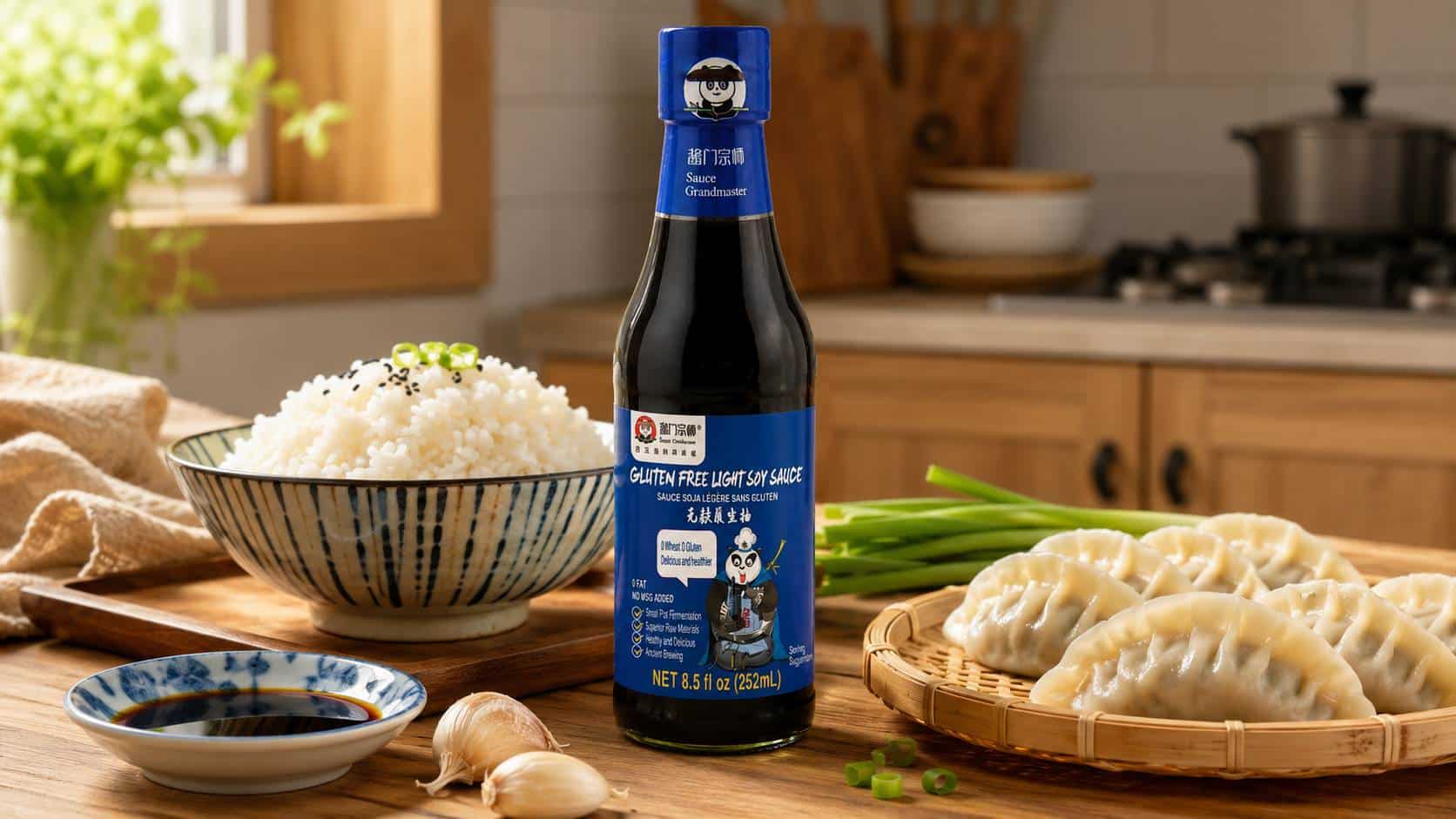
Sauce Grandmaster Gluten-Free Light Soy Sauce is our gluten-free option — the label carries a gluten-free claim. It is still a soy sauce and still contains soy, so it is not suitable for a soy allergy. Store it according to the direction on its label.
For the full explanation of how gluten works in soy sauce, see is soy sauce gluten-free.
K
L
Does soy sauce expire?
It carries a date, but that date is about quality, not safety. An unopened bottle stored cool and dark usually keeps well past it. An opened bottle is better judged by smell, appearance, and texture than by the calendar.
K
L
How long does opened soy sauce last?
There is no universal figure — it depends on the product, how often you open it, and whether it is refrigerated. Quality is best in the first few months after opening and declines gradually after that. Follow your label if it gives a specific instruction.
K
L
Can soy sauce go bad if it is not refrigerated?
It can lose flavor faster, and it can spoil if water, food particles, heat, or a loose cap let contamination in. Refrigeration slows the flavor loss; it does not make a contaminated bottle safe.
K
L
Is it okay to keep opened soy sauce in the pantry?
If you use it several times a week and keep the cap tight, usually yes. If you use it slowly, or the label says to refrigerate after opening, move it to the fridge.
K
L
What does bad soy sauce smell like?
Sour, musty, rotten, or simply "off." Fresh soy sauce smells savory and slightly sweet. If the smell makes you hesitate, discard it.
K
L
Can I cook with old soy sauce?
If it has been stored properly and passes the smell, look, and texture checks, yes — though the flavor will be weaker than a fresh bottle. If it fails any check, discard it. Do not taste it to decide.
K
L
There is no date on my bottle. Is it still safe?
Product dating is not required by federal regulation except for infant formula, so a missing date is normal. Judge it on storage conditions and the three checks above. If the bottle is very old and you cannot account for how it was stored, replace it.
K
L
Does gluten-free soy sauce go bad faster?
Not necessarily — it depends on the formulation, the salt level, and the packaging. Reduced-sodium products in general have less salt working against spoilage, which is why their labels more often call for refrigeration. Check your own bottle.
Bottom line
Soy sauce does go bad, but the timeline is longer and less dramatic than most people expect. The flavor fades first. Safety problems come later, and they almost always have a cause you can point to — water in the bottle, a dirty spoon, a cap left loose, a summer on the countertop.
Store it cool and dark. Close it properly. Follow the direction on your own label. Trust your nose and your eyes.
And if a bottle makes you uneasy, let it go. It is not worth the argument with yourself.
Desly Foods Taste of the world
Welcome to Desly Foods website where you can find our delicious sauce. Our product is made with high-quality ingredients and traditional recipes to ensure the best flavor for your dishes. Whether you are a professional chef or a home cook, our sauce is perfect for adding a touch of sweetness and umami to your favorite recipes.
We take pride in offering a product that not only tastes great but is also made with care and attention to detail. Desly Foods sauce is a staple in many Asian households and we are excited to share it with you.
So why wait? Explore our website and discover the delicious world of our sauce today.
Ready for your next post?
0 Comments