

Pad See Ew Recipe: Thai Stir-Fried Noodles (Gluten-Free Option)
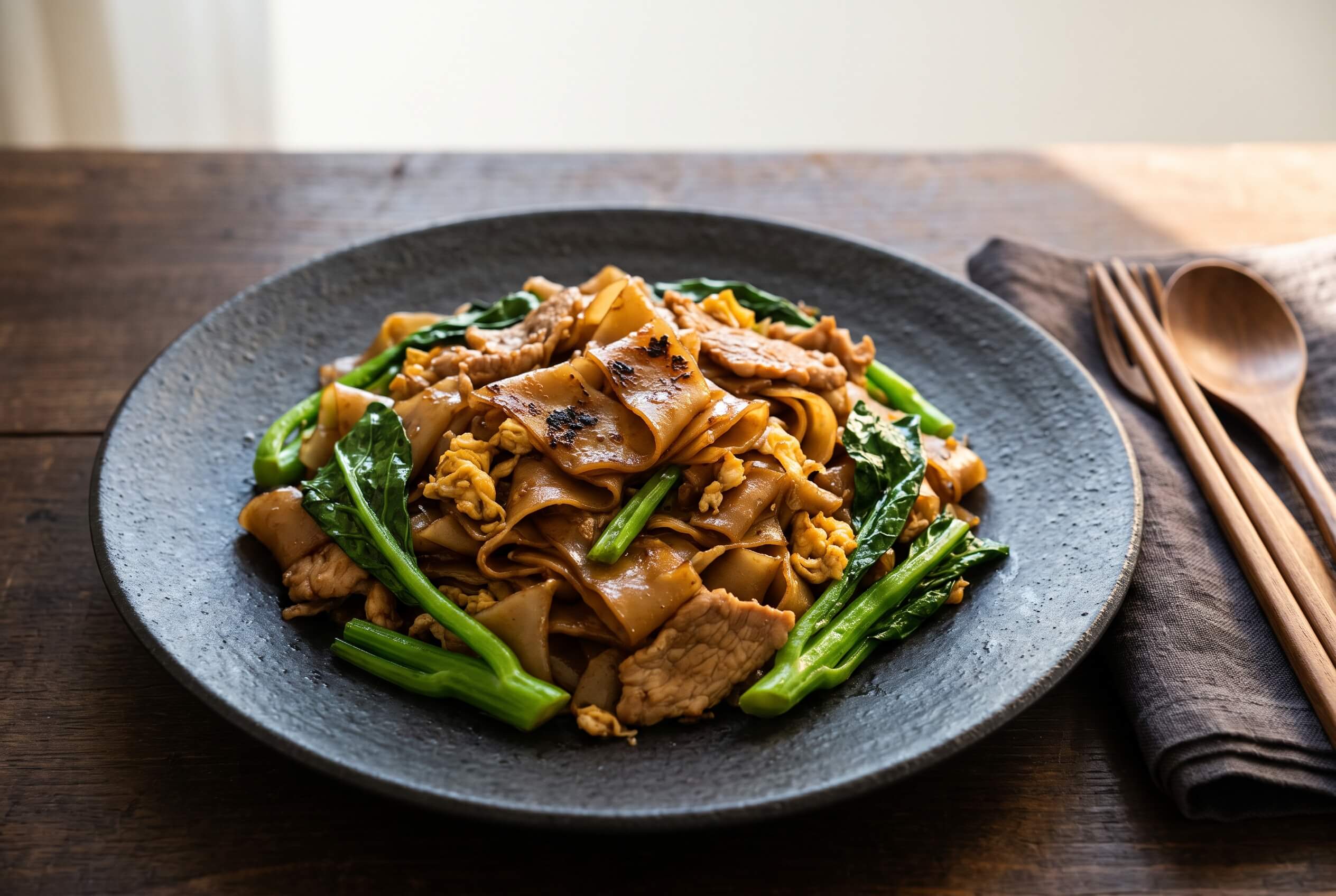
The third time I made pad see ew, I tipped the noodles into the wok and watched them fuse into a single gray brick. Not sticky, not clumped — a brick. That failure taught me more than my first two attempts combined.
Pad see ew is a Thai stir-fried noodle dish that chars wide rice noodles, coats them in sweet dark soy sauce, and folds in egg and Chinese broccoli. It’s what I cook when I want savory and smoky rather than sweet and tangy. Prep runs about 15 minutes — longer if you’re soaking dried noodles — and the wok itself takes six.
Not pad thai. Pad thai gets its punch from tamarind. Pad see ew builds everything on soy, which is why the name is so literal: pad means stir-fried, see ew means soy sauce.
That soy-based sauce is also where the trouble hides.
What is pad see ew?
| Pad See Ew | Pad Thai | |
|---|---|---|
| Noodles | Wide, flat rice noodles (sen yai). Chewy, substantial. | Thin rice noodles. Lighter, more delicate. |
| Sauce base | Dark soy sauce + sweet soy sauce + oyster sauce. | Tamarind paste + fish sauce + palm sugar. |
| Flavor profile | Sweet, salty, deeply savory. Almost no acid. | Sour, sweet, salty all at once. |
| Egg | Scrambled into the noodles, coats everything. | Often served as an omelet wrapper or folded in. |
| Signature topping | Chinese broccoli (gai lan). | Crushed peanuts, bean sprouts, lime wedge. |
| What it can’t do | No sourness, no crunch from raw vegetables. It’s a soft-textured dish. | No smoky char. The sauce is too wet to sear. |
| Best for | A weeknight dinner when you want depth without acid. | When you want brightness and texture contrast. |
What ingredients do you need?
| Ingredient | What it does | Can you substitute it? |
|---|---|---|
| Sen yai (fresh wide rice noodles) | The base. Chewy, flat, takes on char. | Yes, with dried wide rice noodles, soaked and drained. Don’t use thin ones. |
| Dark soy sauce | Colors the noodles nearly black and adds a molasses-thick savoriness. | Not really. Light soy sauce won’t darken the noodles. This is the one ingredient worth a trip. |
| Sweet soy sauce | Brings the sweetness and body. Thick, syrupy, slightly molasses-like. | Yes, in a pinch. See the swap table below. |
| Oyster sauce | Adds the savory backbone. | Yes, with a gluten-free oyster sauce. See the swap table below. |
| Chinese broccoli (gai lan) | Bitter stems, leafy tops. Keeps the dish from being one-note sweet. | Yes. Broccolini, regular broccoli florets, or bok choy all work. |
| Egg | Binds the sauce to the noodles. | No good substitute, and it’s central to the dish. |
| Garlic | Aromatics. Goes in first, hits the oil, perfumes everything. | No. |
| Protein | Optional. Chicken, beef, pork, shrimp, or tofu. | Fully optional. The dish works without it. |
| White pepper | The finishing note Thai cooks use instead of black pepper. | Black pepper works, but it’s a different dish. |
How do you make pad see ew?
Read this once before you start, because the cooking itself moves fast.
Serves 2. Prep: 15 minutes (plus 30–40 minutes if you’re soaking dried noodles). Cook: 6 minutes.
Ingredients
-
- 200 g (7 oz) fresh wide rice noodles (sen yai), or 150 g dried wide rice noodles
-
- 200 g (7 oz) chicken thigh, beef sirloin, or firm tofu, sliced thin
-
- 2 tbsp (30 ml) neutral oil, divided
-
- 3 cloves garlic, roughly chopped
-
- 2 large eggs
-
- 150 g (5 oz) Chinese broccoli, stems sliced on the bias, leaves kept whole
-
- 2 tbsp (30 ml) dark soy sauce
-
- 1 tbsp (15 ml) sweet soy sauce
-
- 1 tbsp (15 ml) oyster sauce
-
- 1 tsp (5 ml) rice vinegar
-
- 1/2 tsp (1 g) ground white pepper
-
- Pinch of sugar, only if your sweet soy sauce is thin

Instructions
1. Get the noodles dry.
Fresh: separate them with your hands and let them sit on a paper towel for 10 minutes. Dried: soak in room-temperature water for 30 to 40 minutes until pliable but still firm, then drain and toss with a teaspoon of oil. Keep dried noodles slightly underdone — they cook a second time in the wok. This is the step that decides the dish.
2. Mix the sauce.
Stir the dark soy sauce, sweet soy sauce, oyster sauce, and rice vinegar together in a small bowl. Do this before the wok goes on — once the oil is hot, you won’t have time to measure anything.
3. Heat the wok until it just starts to smoke.
High heat, no exceptions. Exhaust fan to max, window open.
4. Sear the protein.
Add 1 tablespoon of oil, then the protein in a single layer. Leave it alone for 60 seconds so it browns, then stir-fry until just cooked through. Move it to a plate.
5. Scramble the eggs.
Add the remaining oil and the garlic. Ten seconds later, crack in the eggs and break them into rough curds.
6. Add the Chinese broccoli stems.
Stir-fry for 45 seconds. The stems need a head start on the leaves.
7. Add the noodles. Do not stir.
Slide them in and leave them alone for 30 seconds. Then toss once, let them sit again, and toss again. Two or three rounds is enough.
8. Pour the sauce down the side of the wok.
Not into the middle. Down the hot metal, where it sizzles and caramelizes on the way in. Toss to coat.
9. Return the protein, add the broccoli leaves, and finish.
Toss for 30 seconds. The leaves should wilt, not cook down. Hit it with the white pepper and serve immediately.
Total time from wok-on to plate: about six minutes.
Is pad see ew gluten free?
Here’s where most recipes get it wrong, including a few of the popular ones.
Rice noodles are naturally gluten free. That part is true, and it’s why so many people assume pad see ew is a safe order.
But the noodles were never the problem. The sauce is. Three ingredients in it carry wheat, and they’re the three that define the dish:
- Dark soy sauce. Traditional brewing uses wheat alongside soybeans. Almost every bottle on a standard supermarket shelf contains gluten. We break down exactly how much gluten is in soy sauce here.
- Sweet soy sauce. The thick, syrupy kind used in Thai cooking is usually built on the same wheat-based soy base, then sweetened. Here’s how sweet soy paste and soy sauce differ.
- Oyster sauce. This one surprises people. Oyster sauce is made with soy sauce as its base, and most commercial brands contain wheat.
So a bowl of pad see ew can be gluten free on the noodle side and still make someone with celiac disease sick. The noodles are the least of your worries.
Two more labels to check: fish sauce is usually gluten free, but some producers add wheat. Rice vinegar is gluten free in pure form; flavored or seasoned versions may not be.
Read every bottle. Every time. Manufacturers change formulas without changing the label design.
What a gluten-free label actually means. In the US, a product can only carry the words “gluten-free,” “no gluten,” “free of gluten,” or “without gluten” if it contains less than 20 parts per million of gluten — the lowest level that can be reliably detected by validated lab methods (FDA, Gluten and Food Labeling). “Made without wheat” is not the same claim, and it isn’t regulated the same way.
A note on scope. This article explains how ingredients work. It isn’t medical or dietary advice. If you or someone you cook for has celiac disease or a wheat allergy, follow the guidance of your own clinician and always verify labels on the exact bottles you buy.
How do you make it gluten free?
You swap three bottles, and the dish tastes the same. I’ve made it both ways side by side, and the gluten-free version holds up.
The rule that makes this simple: a gluten-free soy sauce is not a lesser soy sauce, it’s a different one. It’s brewed to skip the wheat, not to water down the flavor.
| Original | Swap with | What you keep | What you lose |
|---|---|---|---|
| Dark soy sauce | Sauce Grandmaster Gluten-Free Mushroom Dark Soy Sauce | The deep color and savory base, plus a soft mushroom aroma | A little of the molasses thickness |
| Sweet soy sauce | Sauce Grandmaster Gluten-Free Light Soy Sauce + 1 tsp brown sugar, simmered 1 minute | The sweetness and body | Nothing meaningful. This swap is nearly invisible. |
| Oyster sauce | Sauce Grandmaster Premium Gluten Free Oyster Sauce | Everything — the brininess, the body, the savory backbone | Nothing. It’s built on oyster juice, not on a soy sauce base, so there’s no wheat to work around. |
| Soy sauce (general) | Sauce Grandmaster Gluten-Free Light Soy Sauce | Clean, salty, savory depth | Nothing. Same amount, one-for-one. |
Oyster sauce is the one people assume they have to give up, and it’s actually the easiest of the three. Most commercial bottles are built on a wheat-based soy sauce — that’s the whole problem. This one isn’t built on soy sauce at all. It’s oyster juice and sugar, thickened. If you want more options anyway, we list oyster sauce substitutes with exact ratios here.
One caution: if you’re skipping soy altogether, you’ll need a different approach entirely. The swaps above all assume soy is fine and only wheat is the problem.
The three bottles this recipe runs on
One bottle for each of the three sauce ingredients that carry wheat by default.

1. Sauce Grandmaster Gluten-Free Light Soy Sauce The everyday bottle. Use it one-for-one anywhere the recipe says “soy sauce,” and as the base for the sweet soy swap above.
2. Sauce Grandmaster Gluten-Free Mushroom Dark Soy Sauce The one that makes the noodles go glossy dark brown. This is your dark soy replacement, and a little goes a long way.
3. Sauce Grandmaster Premium Gluten Free Oyster Sauce 70% oyster content, and no soy sauce anywhere in it — just oyster juice, sugar, and corn starch. That’s why it’s gluten free without any workaround.
For the longer version — which bottles to keep and what to look for on a label — start with Is Soy Sauce Gluten-Free? A Simple Guide for Asian Food Lovers.
Why does it taste so good?
Because of one thing you can’t buy in a bottle: wok hei.
Wok hei translates roughly to “breath of the wok.” It’s the smoky, faintly metallic flavor that shows up when food hits metal hot enough to flash-moisturize its surface. You’re aiming for “lightly charred,” and that’s exactly the line. You can’t fake it in a cold pan, and you can’t add it back afterward.

Three conditions produce it. Every technique in this recipe is one of them.
-
- Heat. The wok has to be past the smoke point of your oil. If you’re not a little nervous, it isn’t hot enough.
-
- Dryness. Water on the noodles has to boil off before the surface can brown. Wet noodles don’t char, they steam — and steamed noodles turn to paste. That’s why step 1 is the step that decides the dish.
-
- Contact. The noodles need uninterrupted time against the metal. Constant motion keeps them from ever browning, and breaks them apart into mush. That’s why step 7 says don’t stir.
The sweet soy sauce does the rest. Sugar caramelizes fast on a hot wok, and that caramel is what gives pad see ew its glossy, almost lacquered look.
Miss the heat and you get a sweet, soggy noodle dish. Hit it and you get something that tastes like it came off a cart in Bangkok.
How do you stop the noodles turning into a brick?
This is the failure I opened with. It has four causes, and each one breaks one of the three conditions above.
Wet noodles. The biggest one. Fresh noodles carry surface moisture and often a film of oil from the package; dried ones hold water in the folds. Spread the fresh ones out and let them dry. Drain the dried ones thoroughly, then toss them with oil.
A cold wok. Noodles in a medium-hot wok release starch and steam instead of searing. Heat the wok dry first, then add oil, then add food. In that order.
Overcrowding. A 12-inch wok comfortably handles two servings. Four servings in the same wok steams. Cook in batches and combine at the end.
Stirring too much. This feels wrong, but it’s the most common mistake. Let them sit. Toss. Let them sit again.
One honest limitation: on an electric coil or a weak induction burner, you may never get true wok hei. Home burners in the US and Europe put out far less heat than a commercial range. You’ll still get a good dish. You won’t get a street-cart one. A cast-iron skillet preheated for five minutes beats a cold wok.
What protein and vegetables work best?
The protein is flexible. The vegetables are less so — they have to survive high heat without releasing water. The rule that covers both: anything that cooks fast and stays firm works. Anything watery or delicate doesn’t.
| Protein | Prep note | Works? |
|---|---|---|
| Chicken thigh | Slice against the grain, 1/4-inch thick | Yes. Most forgiving. |
| Beef sirloin or flank | Slice thin, against the grain | Yes. Sear hot and fast. |
| Pork shoulder | Thin slices, marinate 10 min in a little soy | Yes. Classic street-cart choice. |
| Shrimp | Peeled, patted very dry | Yes. Cooks in 60 seconds. Add last. |
| Firm or extra-firm tofu | Press 15 min, cube, pan-fry first | Yes. Press it or it steams. |
| Ground meat | — | No. Releases too much fat and water. |
| Vegetable | Prep note | Works? |
|---|---|---|
| Chinese broccoli (gai lan) | Stems on the bias, leaves whole | Yes. The traditional choice. |
| Broccolini | Halve the thick stems | Yes. Closest easy substitute. |
| Bok choy | Separate stems and leaves | Yes. Add stems early, leaves last. |
| Carrot | Thin coins or ribbons | Yes, in small amounts. Adds color. |
| Bean sprouts | — | Only at the very end, or they go limp. |
| Napa cabbage | — | No. Too much water. |
| Bell pepper | — | No. Sweet and watery. Fights the sauce. |
Two proteins in one wok is fine. Three is too many, because each one needs its own sear time.
If you like this style of cooking, this beef and broccoli stir-fry follows the same high-heat logic.
What mistakes ruin pad see ew?
hese are the flavor mistakes. The texture ones are in the section above.
Using light soy sauce instead of dark. Light soy is salty and thin. It’ll leave your noodles pale and gray, and the color is part of the dish. Here’s what dark soy sauce is actually for.
Mixing the sauce after the wok is hot. You’ll be measuring while your garlic burns. Bowl first, wok second.
Pouring the sauce into the middle of the wok. It pools and steams. Down the side, it caramelizes on the way in. Same ingredients, completely different result.
Cooking the broccoli leaves with the stems. The leaves need 30 seconds. The stems need 90. Together, you get slime.
Tasting only at the end. With this much soy in the pan, you can overshoot salt fast. Taste right after the sauce goes in, not after you plate.
K
L
What does pad see ew taste like?
Sweet, salty, and deeply savory, with a smoky edge from the charred noodles. There's almost no acidity, which is what separates it from pad thai.
K
L
Is pad see ew the same as pad thai?
No. They use different noodles, sauces, and toppings. Pad thai is sour and sweet, built on tamarind. Pad see ew is savory and sweet, built on dark soy sauce.
K
L
Is pad see ew gluten free?
Not by default, even though the noodles are. The sauce usually contains three wheat-based ingredients: dark soy sauce, sweet soy sauce, and oyster sauce. Swap all three and it is.
K
L
What can I use instead of dark soy sauce?
A gluten-free dark soy sauce — Sauce Grandmaster Gluten-Free Mushroom Dark Soy Sauce gives you the color and body in one bottle. Regular light soy sauce won't give you the color.
K
L
Can I use regular soy sauce if I'm not avoiding gluten?
Yes, for the general sauce. But you still want dark soy sauce specifically for the color and body. They're not interchangeable.
K
L
What noodles do I use for pad see ew?
Wide, flat rice noodles. Fresh ones are sold as sen yai. Dried wide rice noodles work if you soak them until pliable but still firm, then drain thoroughly. Never use thin noodles.
K
L
Can I make pad see ew without a wok?
Yes. Use a large cast-iron skillet or heavy carbon steel pan, preheat it five minutes over high heat, and cook in two batches. Less wok hei, same dish.
K
L
Why are my noodles mushy?
Moisture. Either the noodles were still wet, the wok wasn't hot enough, or the pan was overcrowded. See the brick section above.
K
L
Is oyster sauce gluten free?
Usually not. Most commercial oyster sauces use soy sauce as a base, and that soy sauce is brewed with wheat. But some are built on oyster juice instead, with no soy sauce anywhere in the recipe. Check the ingredient list, not just the front label.
K
L
Can I make pad see ew vegan?
Yes. Skip the egg, use firm tofu, and replace the oyster sauce with an extra tablespoon of gluten-free mushroom dark soy sauce. Add a teaspoon of oil at the end to bring back some richness.
K
L
How do I store and reheat leftovers?
Refrigerate in an airtight container up to three days. Reheat in a hot skillet with a splash of water — the microwave brings back the exact mushy texture you spent six minutes avoiding.
K
L
What's the difference between pad see ew and pad kee mao?
Pad kee mao, or drunken noodles, uses the same wide rice noodles but adds chili and Thai basil. It's spicy and herbal where pad see ew is sweet and savory. The noodle handling is identical.
Related Reading
The thing I’d tell you before you start
The first pad see ew I made was a gray brick. The second was better but sweet and limp. The third one, the one that finally worked, took six minutes in the wok after twenty minutes of prep I’d been skipping.
That’s the whole trick. The wok part is fast and loud. The prep part is quiet and boring, and it’s the part that decides whether dinner works.
Dry your noodles. Get the wok properly hot. Pour the sauce down the side.
Then let it sit.
Desly Foods Taste of the world
Welcome to Desly Foods website where you can find our delicious sauce. Our product is made with high-quality ingredients and traditional recipes to ensure the best flavor for your dishes. Whether you are a professional chef or a home cook, our sauce is perfect for adding a touch of sweetness and umami to your favorite recipes.
We take pride in offering a product that not only tastes great but is also made with care and attention to detail. Desly Foods sauce is a staple in many Asian households and we are excited to share it with you.
So why wait? Explore our website and discover the delicious world of our sauce today.
Ready for your next post?
0 Comments